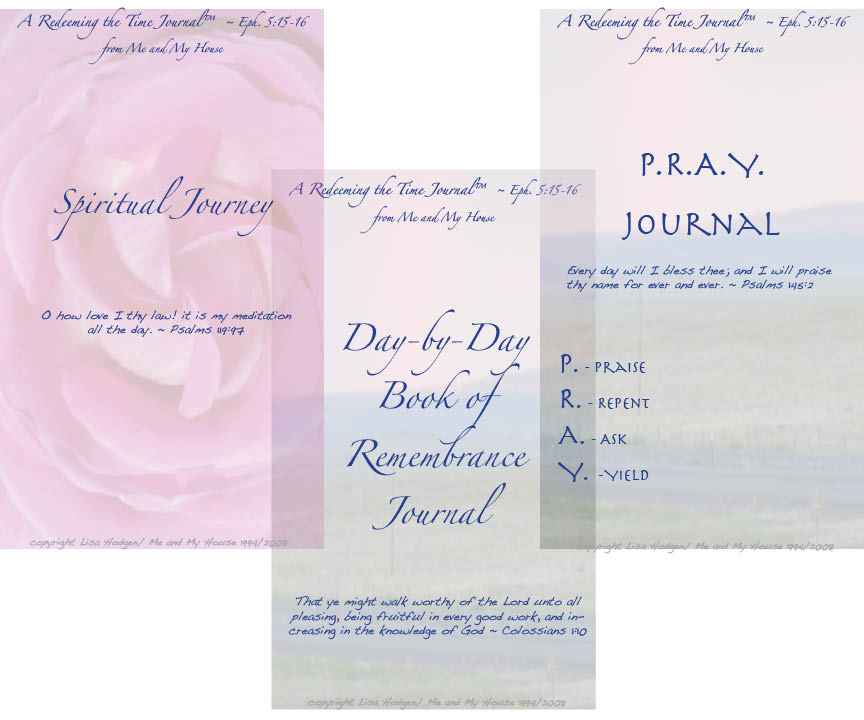
You’ve been asking and waiting for this one! Redeeming the Time Journal™ forms are back! Well, making a comeback anyhow.

I’ve reformatted your 3 favorites, that are requested most – Spiritual Journey, P.R.A.Y., and Day-by-Day Book of Remembrance Journal. Now with design choices and more formats to choose from. And ready for you to download, and print the ones you want, as many as you want for your own immediate family.

See the details and order Redeeming the Time Journal™ Favorite Forms here. SPECIAL SAVINGS when you buy Redeeming the Time Journal™ Favorite Forms and Refrigerator Charts Master Pack together.

FYI, the Redeeming the Time Journal™ Education forms are just about ready for re-release too!

For Me and My House ~ At Jesus’ feet,
Lisa @ Me and My House ~ Discipleship for Life!
Order Christian & Home Ed Resources here

Get future posts to this blog by email:

Your email:


0

I’ve been discussing Learning Maps™ and mind-mapping software with several of you and others for a while now. That is also the section I’m currently working on in my new book (soon to be released, Lord willing). That has sent me to further research. So here’s some info to add to previous posts. (And look for my new book to come out, that will have a complete section on Learning Maps™ – what they are and why and how to use them.)

I believe there are 4 contenders for making good mind-maps on the computer. Gratefully, they are now all available for both Mac and windows computers. All of them will cost you something. But all of them also come with free trial periods (at their home websites.) So you can test them out and even compare them to see which you like best before purchasing. FreeMind seems to be the best free, as in no-cost, mind-mapping software, but it still doesn’t have the features that make mind-mapping the effective learning tool that it is meant to be. So I don’t consider it a contender.

The newest Mind Mapping software is the only one that has incorporated all of the features that make Mind Mapping the powerful learning tool that it is. I’m just getting started with it. So before I tell you more about it, I’ll tell you about the other three – that I know more about.

As previously announced, we are now affiliates of NovaMind, one of our favorite mind-mapping programs we’ve been using. Since I wrote on it a couple weeks ago, I won’t add more right now.

Inspiration, the other program I own and am currently using, can be purchased  through our Amazon affiliate link. You can also download a free trial at Inspiration’s website. Inspiration was written as educational software, so is more specific to the education market than NovaMind, and a bit easier to use, but doesn’t have as many features.

MindManager, the first mind-mapping software I purchased, MANY years ago, is now available for Mac computers. (It was windows only when I got it, which is why I switched to the other two I use now.) It looks like it has been improved, and even better than when I was using it. I don’t have intentions of repurchasing it, but am working with the free trial now. It also can be purchased through our Amazon affiliate link.  You can also download a free trial of MindManager at their website.

iMindMap - Free Download

iMindMap is the newest of the four, but developed by the originator of Mind Mapping®. Since I already had 3 mind-mapping programs, I didn’t even notice that Tony Buzan had finally created his own. It works much more like hand-drawn mind maps than any of the others, increasing its effectiveness. As Buzan says, “A Mind Map created by you is far more powerful than one created for you.” I am testing it out now. Do I really want to buy ANOTHER mind mapping program? Ouch.

iMindMap is also the newest we have an affiliate partnership with. Their current offer is if you purchase version 2 before version 3 comes out next month, he’ll give you the top edition of version 3 (of 3 new levels) for free when it comes out. You will pay just over what the lowest new edition will cost. It’s not the cheapest mind-mapping application, but OTOH far cheaper than some of the business software I have that I use far less – and it offers more of what Mind Mapping should be than the others.

For Me and My House ~ At Jesus’ feet,
Lisa @ Me and My House ~ Discipleship for Life!
Order Christian & Home Ed Resources here

Get future posts to this blog by email:

Your email:


0

Excerpt from our May ‘08 Me and My House musings email newsletter:

We love books! So we have bookcases in every room of the house – including the bathrooms! and a "library" room, too!

So, how do I keep track of all these books? Well, when children sneak them off and don’t return them, I have been known to buy duplicates. I see a book, and think, "Hmm, I know that’s been on my to-buy list for several years, but I thought I bought it." I look on the shelf, where it should be, and it isn’t there, so I buy it again. Only later – usually much later – to have the original show up in some child’s possession. Actually, maybe this is their way of ensuring there is an extra copy of the book for them to take with them when they are grown. Hmm.

My first tactic for keeping track of our books, is having a place for each kind. Yes, there is a method to my madness. Different types of books are in each room, and our library is organized, not by the dewey decimal system, but by my own system. But even if you don’t have as many books or bookcases as I do, grouping them by type will help you organize your books.

But, I have one more invaluable method for helping me keep track of all we have. The not-so-secret answer is a computer database. I used to have a file sheet I made (in Access), but now I have a much easier option – software called Booxter. Booxter is a database for books! Enter the ISBN number and it will look up and fill in all the other information about your books (if you have access to the internet, and if the books have an ISBN. Of course my old books don’t, so I have to enter them by hand.) You just add any other notes you care to make – about the location of the book, where you bought it, price paid, notes, etc. – or nothing at all!

You can also, in Booxter, organize your books into files, for easy browsing through various categories, and of course you can search your list. You can even export your list to your iPod, so you can carry it with you! I haven’t tried that yet, but it will be invaluable when we go to homeschool conventions! [Update: I have and it is.]

Booxter is only for Mac computers. But I just did a google search for "book organizer app" and "book database software" and found several for PC. Give one a free trial and see if it will help you with your book collections.

For Me and My House ~ At Jesus’ feet,
Lisa @ Me and My House ~ Discipleship for Life!
Order Christian & Home Ed Resources here

Get future posts to this blog by email:

Your email:


2

Excellent article by Richard Jones, from American Vision today. Here’s the last part. Be sure to read the whole article here.

"… What most Christian leaders don’t understand, however, nor does Barna, is how badly they’ve been blindsided by Antonio Gramsci, a man unknown to all but a few. A brilliant Marxist, Gramsci (1891–1937) saw that if his cause was to prevail globally it would be vital that young, pliable minds be molded with anti-Christian, Bible-defaming and pro-special interest worldviews. His insightful plot has slowly but steadily percolated up into the activist agendas of those on the God-hating left; those who, themselves, couldn’t even tell you who he is. But they have learned this: If they’re “given the child” during the formative years that child will be theirs forever. Which is exactly what they’re achieving. That’s what Falwell and Wildmon and the rest are up against today, and if fighting fire with fire on our part doesn’t immediately come to mind as a counter tactic, it should.

"The “deeper thing” needed that I referred to is this, and it relates to the near-automatic love of parents for children: The only realistic way to restore and re-implant Christian thought and action in a dying culture is for pulpits (and through them, the parents) to zero in on the minds of those not yet “Gramsci programmed.” … Unless the evangelistic “step one” of John 3:16 is supplemented by daily, lifelong doses of 2 Timothy 3:16–17, we’re going to lose. Not Christendom at large, but us, here, in the U.S."


0

Ruth Haycock’s Encyclopedia of Bible Truths is currently on a WOW! Special at CBD. Three of the individual books are 37-42% off! WOW! That $6.something and $7.something per book! (Thanks Mandi for the heads-up.)

They are WOW resources – you can read more about why we use them through the catalog links below too. Here’s the links – both direct and catalog pages. These special prices can end at any time.

Encyclopedia of Bible Truths: Language Arts/English

31136X: Encyclopedia of Bible Truths: Language Arts/English Encyclopedia of Bible Truths: Language Arts/English
By Ruth C. Haycock / Assoc. Of Christian Schools

This series integrates the Bible into virtually every curriculum area and is an outstanding resource for lesson preparation, research, and project completion. The series is formatted by content area; each section lists biblical concepts and background for that subject. Scripture references and scriptures that pertain to those concepts are then provided.

See this book (and others in this category) on this Me and My House Resources and Recommendations page.

Encyclopedia of Bible Truths: Social Studies

311394: Encyclopedia of Bible Truths: Social Studies Encyclopedia of Bible Truths: Social Studies
By Ruth C. Haycock / Assoc. Of Christian Schools

This series integrates the Bible into virtually every curriculum area and is an outstanding resource for lesson preparation, research, and project completion. The series is formatted by content area; each section lists biblical concepts and background for that subject. Scripture references and scriptures that pertain to those concepts are then provided.

See this book (and others in this category) on this Me and My House Resources and Recommendations page.

Encyclopedia of Bible Truths: Fine Arts/Health

311378: Encyclopedia of Bible Truths: Fine Arts/Health Encyclopedia of Bible Truths: Fine Arts/Health
By Ruth C. Haycock / Assoc. Of Christian Schools

Infuse your teaching with the timeless messages of God’s Word! Highlight how the creation reflects the Creator in music, the fine arts, crafts, health, and physical education. Designed to stimulate the study of all truth as God’s truth, this supplemental resource helps you integrate scriptural perspectives throughout standard subjects. Includes research projects for most chapters. 116 pages, softcover from Purposeful Design.

See this book (and others in this category) on this Me and My House Resources and Recommendations page.

The fourth book in the series – not currently on sale, just CBD’s every day discount price.

311386: Encyclopedia of Bible Truths: Science/Mathematics Encyclopedia of Bible Truths: Science/Mathematics
By Ruth C. Haycock / Assoc. Of Christian Schools

This series integrates the Bible into virtually every curriculum area and is an outstanding resource for lesson preparation, research, and project completion. The series is formatted by content area; each section lists biblical concepts and background for that subject. Scripture references and scriptures that pertain to those concepts are then provided.

I also heard there is a Free shipping special right now – use code #272495 until Sept. 30th.


0

Just wanted to let you know Cindy Rushton is hosting a online seminar this Weekend–July 11-12. In fact it is starting RIGHT NOW!

Let’s Get Organized for the New School Year Virtual Seminar!

Sign up today to join us live (just register with your name/email for us to send you the passwords and schedule updates) or grab a ticket for access to our

Membership Site AND free ebooks/audios!

Sign up here: http://www.CindyRushton.com/LGO2008.html

I won’t take anymore time to elaborate much more, since it’s already starting. Just go to the link above to get the info.

But I will say – IT IS NOT TOO LATE! Listen live as you can – and buy a member ticket to listen and download all the goodies offered at your convenience – even long after the "live" part is over.


0

The Difference – in a Nutshell.

I’m often asked what the differences are between L.E.D./ biblically principled approaches to education and other Christian curricula.

Four primary differences, in a very simple explanation, are that biblically principled education is:

Reflection. It is based on looking deeply into the topic and ruminating on it, giving the student time to think about it before moving on or requiring output from him. We think through the context and connections, finding relationships and applications in our own lives.  It is not based on putting facts in then turning around and spitting them back out.

Biblical reasoning. It is based on looking at every topic studied through the light of the Scripture, reasoning from God’s Word to see His perspective of what is studied. It is not just attaching a verse to a page.

Biblical principles. It is based on finding principles from God’s Word applied or violated, choice -> consequence, cause -> effect, internal -> external. We want to take our studies back to the source and origin, to find their purpose and their principles. We want our studies to change us, to cause us to grow more Christ-like, and to grow in having the mind of Christ in all areas of life, not just Bible study or character classes.

Discipleship. It is based on building relationships, leading along the way of life, through the things of life, sharing “these words” that are in our heart, our passions and desires, and seeking God’s ways together.

Does that help? :-)

For Me and My House ~ At Jesus’ feet,
Lisa @ Me and My House ~ Discipleship for Life!
Order Christian & Home Ed Resources here

Get future posts to this blog by email:

Your email:


0

The Internet can be a tremendous blessing. It allows us to reach more people than we can face to face, with the Gospel of Jesus Christ and the teachings of His Word. It can present useful ideas for us to think about, that we may not come in contact with elsewhere. It is an avenue that can be of great benefit.

On the other side, …

I was just proofreading some writing yesterday, covering the topic of being cautious in using the Internet. There are so many reasons.

  • Identity theft – or personal theft (kidnappings, violence, etc.) – Be cautious about the info you give out.
  • False information – anyone can say anything, true or false, publish it to a lot of websites and plenty of people will believe it. (Was it Hitler who said if you repeat a lie often enough, people will believe it?) – Be cautious about the info you take in.
  • Evil content – this world is full of evil, and it all makes it’s way onto the Internet. But now you don’t have to go out into shadey parts of town to find it. It can come straight into your own home. – Be cautious about the places and people you allow to "visit" your home.
  • Promotion of a-musement – we live in an entertainment obsessed society, desiring to turn off the brain and just be. Be acted upon rather than act, spectate rather than do. Our society is not only growing dumber, they don’t care. Why think or learn when you have all the knowledge of the world at the tips of your fingers to pass on to others? Why make your mind work and store things when you have 250 GB of hard storage plus unfathomable info for the taking sitting on your desk? Eat, drink and be merry for tomorrow we die.

    • TV, video and computer games have lulled our society to sleep.
    • Email, instant messaging, and cell phone texting has lowered our society’s literacy requirements and expectations tremendously. Not only can they not write or spell. Now they don’t have to, and are encouraged not to.
    • It’s promoted an inactive, unhealthy society. Why get up and do anything, when I have the world at my fingertips, and I can "virtually participate"?
    • Be cautious that you don’t turn your mind off. Think about what you see and read, process it, adopt it wisely and promote it with clarity.
    • Be cautious about the amount of time you spend on it. Get up and go do something physically productive!

I’m sure there are more reasons, but the one that troubles me most is the numbing and dumbing aspect. Two books I’ve recommended for quite some time have sounded the warning -  Dumbing Us Down: The Hidden Curriculum of Compulsory Schooling by John Taylor Gatto, 1992   and Endangered Minds by Jane Healy, 1990 – both long before the public Internet.

Today, American Vision’s email addressed this issue, from a bit different angle. Below is a bit of what they said. Read the whole article here.

Mark Bauerlein is warning about what he describes as the “The Dumbest Generation: How the Digital Age Stupefies Young Americans and Jeopardizes Our Future” (2007) [or read his 8 points here]. Nicholas Carr, writing in July/August 2008 issue of the Atlantic Monthly asks, “Is Google Making Us Stupid?[Don't miss reading this one!] Don’t get me wrong. I love the digital age and what it has done to make gobs of information available in a blink of an eye. It’s unfortunate, however, that many people never learned that there are pitfalls and obstacles in the information business.

Is the Internet Making Some People Stupid and Gullible?
- Gary DeMar, July 8, 2008

[my comments in brackets]

DeMar notes the article "Is Google Making Us Stupid?" I clicked the link, since this is a topic of interest to me, and ended up spending more time than a wanted online, reading an unusual-by-its-length article. Carr speaks the things I’ve concluded about this, and below I’ve pasted many quotes from the article that struck me. Read the whole article here.:

…Over the past few years I’ve had an uncomfortable sense that someone, or something, has been tinkering with my brain, remapping the neural circuitry, reprogramming the memory. My mind isn’t going—so far as I can tell—but it’s changing. I’m not thinking the way I used to think. I can feel it most strongly when I’m reading. Immersing myself in a book or a lengthy article used to be easy. My mind would get caught up in the narrative or the turns of the argument, and I’d spend hours strolling through long stretches of prose. That’s rarely the case anymore. Now my concentration often starts to drift after two or three pages. I get fidgety, lose the thread, begin looking for something else to do. I feel as if I’m always dragging my wayward brain back to the text. The deep reading that used to come naturally has become a struggle.

I think I know what’s going on. For more than a decade now, I’ve been spending a lot of time online, searching and surfing and sometimes adding to the great databases of the Internet. …

…media are not just passive channels of information. They supply the stuff of thought, but they also shape the process of thought. And what the Net seems to be doing is chipping away my capacity for concentration and contemplation. My mind now expects to take in information the way the Net distributes it: in a swiftly moving stream of particles. Once I was a scuba diver in the sea of words. Now I zip along the surface like a guy on a Jet Ski….

…“I was a lit major in college, and used to be [a] voracious book reader,” he wrote. “What happened?” He speculates on the answer: “What if I do all my reading on the web not so much because the way I read has changed, i.e. I’m just seeking convenience, but because the way I THINK has changed?”…

…the Internet has altered his mental habits. “I now have almost totally lost the ability to read and absorb a longish article on the web or in print,”…

…thinking, he said, has taken on a “staccato” quality, reflecting the way he quickly scans short passages of text from many sources online. “I can’t read War and Peace anymore,” he admitted. “I’ve lost the ability to do that. Even a blog post of more than three or four paragraphs is too much to absorb. I skim it.”…

…The authors of the study report:

It is clear that users are not reading online in the traditional sense; indeed there are signs that new forms of “reading” are emerging as users “power browse” horizontally through titles, contents pages and abstracts going for quick wins. It almost seems that they go online to avoid reading in the traditional sense. …

…Wolf worries that the style of reading promoted by the Net, a style that puts “efficiency” and “immediacy” above all else, may be weakening our capacity for the kind of deep reading that emerged when an earlier technology, the printing press, made long and complex works of prose commonplace. When we read online, she says, we tend to become “mere decoders of information.” Our ability to interpret text, to make the rich mental connections that form when we read deeply and without distraction, remains largely disengaged. …

…the media or other technologies we use in learning and practicing the craft of reading play an important part in shaping the neural circuits inside our brains. …We can expect as well that the circuits woven by our use of the Net will be different from those woven by our reading of books and other printed works. …

…“‘thoughts’ in music and language often depend on the quality of pen and paper.”… [interesting thought - just pasted to think upon :-) Could it possibly have some validity? Don't know.]

…The Internet, an immeasurably powerful computing system, is subsuming most of our other intellectual technologies. It’s becoming our map and our clock, our printing press and our typewriter, our calculator and our telephone, and our radio and TV.

When the Net absorbs a medium, that medium is re-created in the Net’s image. It injects the medium’s content with hyperlinks, blinking ads, and other digital gewgaws, and it surrounds the content with the content of all the other media it has absorbed. A new e-mail message, for instance, may announce its arrival as we’re glancing over the latest headlines at a newspaper’s site. The result is to scatter our attention and diffuse our concentration.

The Net’s influence doesn’t end at the edges of a computer screen, either. As people’s minds become attuned to the crazy quilt of Internet media, traditional media have to adapt to the audience’s new expectations. Television programs add text crawls and pop-up ads, and magazines and newspapers shorten their articles, introduce capsule summaries, and crowd their pages with easy-to-browse info-snippets. … the “shortcuts” would give harried readers a quick “taste” of the day’s news, sparing them the “less efficient” method of actually turning the pages and reading the articles. …

…Taylor’s ethic [of industrial manufacturing] is beginning to govern the realm of the mind as well. The Internet is a machine designed for the efficient and automated collection, transmission, and manipulation of information, and its legions of programmers are intent on finding the “one best method”—the perfect algorithm—to carry out every mental movement of what we’ve come to describe as “knowledge work.”

Google’s headquarters, in Mountain View, California—the Googleplex—is the Internet’s high church, and the religion practiced inside its walls is Taylorism. Google, says its chief executive, Eric Schmidt, is “a company that’s founded around the science of measurement,” and it is striving to “systematize everything” it does. … What Taylor did for the work of the hand, Google is doing for the work of the mind. …

…In Google’s view, information is a kind of commodity, a utilitarian resource that can be mined and processed with industrial efficiency. …

… [Google's founders] speak frequently of their desire to turn their search engine into an artificial intelligence, a HAL-like machine that might be connected directly to our brains. “The ultimate search engine is something as smart as people—or smarter,” Page said in a speech a few years back. “For us, working on search is a way to work on artificial intelligence.” In a 2004 interview with Newsweek, Brin said, “Certainly if you had all the world’s information directly attached to your brain, or an artificial brain that was smarter than your brain, you’d be better off.” …

…their easy assumption that we’d all “be better off” if our brains were supplemented, or even replaced, by an artificial intelligence is unsettling. It suggests a belief that intelligence is the output of a mechanical process, a series of discrete steps that can be isolated, measured, and optimized. In Google’s world, the world we enter when we go online, there’s little place for the fuzziness of contemplation. Ambiguity is not an opening for insight but a bug to be fixed. The human brain is just an outdated computer that needs a faster processor and a bigger hard drive.

The idea that our minds should operate as high-speed data-processing machines is not only built into the workings of the Internet, it is the network’s reigning business model as well. The faster we surf across the Web—the more links we click and pages we view—the more opportunities Google and other companies gain to collect information about us and to feed us advertisements. … The last thing these companies want is to encourage leisurely reading or slow, concentrated thought. It’s in their economic interest to drive us to distraction. …

After relating the mixed blessing and curse of the Internet, Carr concludes:

Then again, the Net isn’t the alphabet, and although it may replace the printing press, it produces something altogether different. The kind of deep reading that a sequence of printed pages promotes is valuable not just for the knowledge we acquire from the author’s words but for the intellectual vibrations those words set off within our own minds. In the quiet spaces opened up by the sustained, undistracted reading of a book, or by any other act of contemplation, for that matter, we make our own associations, draw our own inferences and analogies, foster our own ideas. Deep reading, as Maryanne Wolf argues, is indistinguishable from deep thinking.

If we lose those quiet spaces, or fill them up with “content,” we will sacrifice something important not only in our selves but in our culture. …

…we risk turning into “‘pancake people’—spread wide and thin as we connect with that vast network of information accessed by the mere touch of a button.”…

Read the whole article to
put all these quotes in context.

Is Google Making Us Stupid?
by Nicholas Carr

(I don’t know anything else about this author – but this article rings true with me. Even though the Atlantic Monthly, where it is posted, is loaded with Obama for Pres banners. – God help us.)

Perhaps this is why we at Me and My House promote learning based on "old paths" – those time proven methods of seeking wisdom, understanding, and knowledge, which God declares bring success.

The Internet can be a help as we teach and learn. If you choose to use it, since you have – noted by the fact that you are reading this :-) – supplement with the Internet judiciously. Use it sparingly. Use it cautiously. Never forget it is reflective learning that leads to wisdom.

Pray for the completion of R Road to Biblical Wisdom – hopefully to be published this month. (The link is not live yet, but will be soon.)

For Me and My House ~ At Jesus’ feet,
Lisa @ Me and My House ~ Discipleship for Life!
Order Christian & Home Ed Resources here

Get future posts to this blog by email:

Your email:


5

Vision Forum’s History of the World MegaPack is an incredible set of DVD’s and CD’s! I have enjoyed it immensely.

For the first time, Vision Forum is pleased to offer its History of the World MegaPack online — a gargantuan collection of scholarly, yet accessible resources that explain God’s hand in world history. And, as a special introductory bonus, we are offering a 55% discount on this series from now through July 14, 2008. Order the History of the World MegaPack now and pay just $189 — that’s $231 off the $420 retail price!

MegaPack Includes:

  • The History of the World: B.C. (20 CDs approx. 19 hrs.)

  • The History of the World: A.D. (20 CDs approx. 19 hrs.)

  • The History of the World (10 DVDs over 11 hrs.)

  • Providential Battles (4 CDs approx. 5 hrs.)

  • Providential Battles II (4 CD approx. 4 hrs.)

  • Sabers, Spears, and Catapults(4 CD approx. 4 hrs.)
    10 DVDs

That’s 63+ hours of combined audio and video — For Only $189!

Take advantage of this limited-time offer and equip your family with an understanding of God’s providential hand in world history! Offer ends at midnight (CDT) on July 14, 2008.


0

Had to add another resource I found today, an Independence Day picture with quotes. It’s from Hobby Lobby, and you can download a free pdf of it and print it out.

Please read my other, full post, today too.


0